


Over 100 marketing emails reach the inbox of an average UK consumer – every week. Add to that social ads and the relentless pop-up ads, and it’s hardly a surprise to learn that people are actively cutting down their screen time and that between 20% and 30% of consumers have deleted a social media app in the past 12 months.
Compared to the 100+ weekly emails, UK consumers receive only 7–12 pieces of print marketing each week. That difference matters. In an environment defined by digital saturation and fatigue, physical marketing stands out precisely because it is rare. A well-designed printed postcard doesn’t blend in – it interrupts the pattern.
Why print advertising is as relevant as ever
Print advertising outperforms digital on attention, recall and emotional engagement – and the data backs it up.
In addition to being immediately noticeable, print marketing materials get more repeat attention than digital ads and emails do. JICMAIL data shows that people wait for 5-11 days on average before discarding pieces of direct mail at home.
Where a social ad disappears with a swipe, a well-designed flyer on a coffee table gets picked up, glanced at and reconsidered multiple times over several days. Unsurprisingly, recall rates of offline marketing materials beat email by almost 50%.
Unopened email can’t seem to compete with the sheer physical presence of print advertising. Royal Mail research suggests that printed mail requires more emotional processing, which strengthens memory and brand recognition. Other studies show that simply touching a physical object increases positive associations and perceived value. Ever noticed how you’re almost magnetically drawn to pick up products or run your fingers through racks of clothes when you shop? Turns out we’re hardwired to do so.
Direct mail marketing: Bypassing the spam folder
The competition for attention is far higher in the inbox than in the real world. Even when it doesn’t land in the spam folder, email is often left unread and batch-deleted without ever being opened.
Print marketing materials, on the other hand, can be precisely targeted to the right context – reaching people where and when they are most likely to engage.
Take targeting post codes based on a demographic match, for example: A children’s activity centre in Bristol could target Bishopston and Henleaze with a summer holiday campaign, while a garden landscaping business in London might focus premium services on Richmond and Chiswick.
With offline marketing, instead of shouting into the void, you’re putting your message directly into the hands of the people most likely to become customers.
The core print marketing materials you actually need
Start with the tried-and-tested classics that consistently deliver results and won’t break the budget – the quality of the design and the print is what matters most.
Tip
Websites like VistaPrint help you create professional, high-quality designs without having to hire a designer. Built-in design tools, customisable templates and accessible expert help mean you can make any piece of print marketing earn its keep.
The essential print marketing materials for a small local business
Business cards
Yes, business cards are still the best way to share your details in a physical setting – at a local fair, a networking event, or even in your shop when curious passers-by drop in but are not ready to commit.
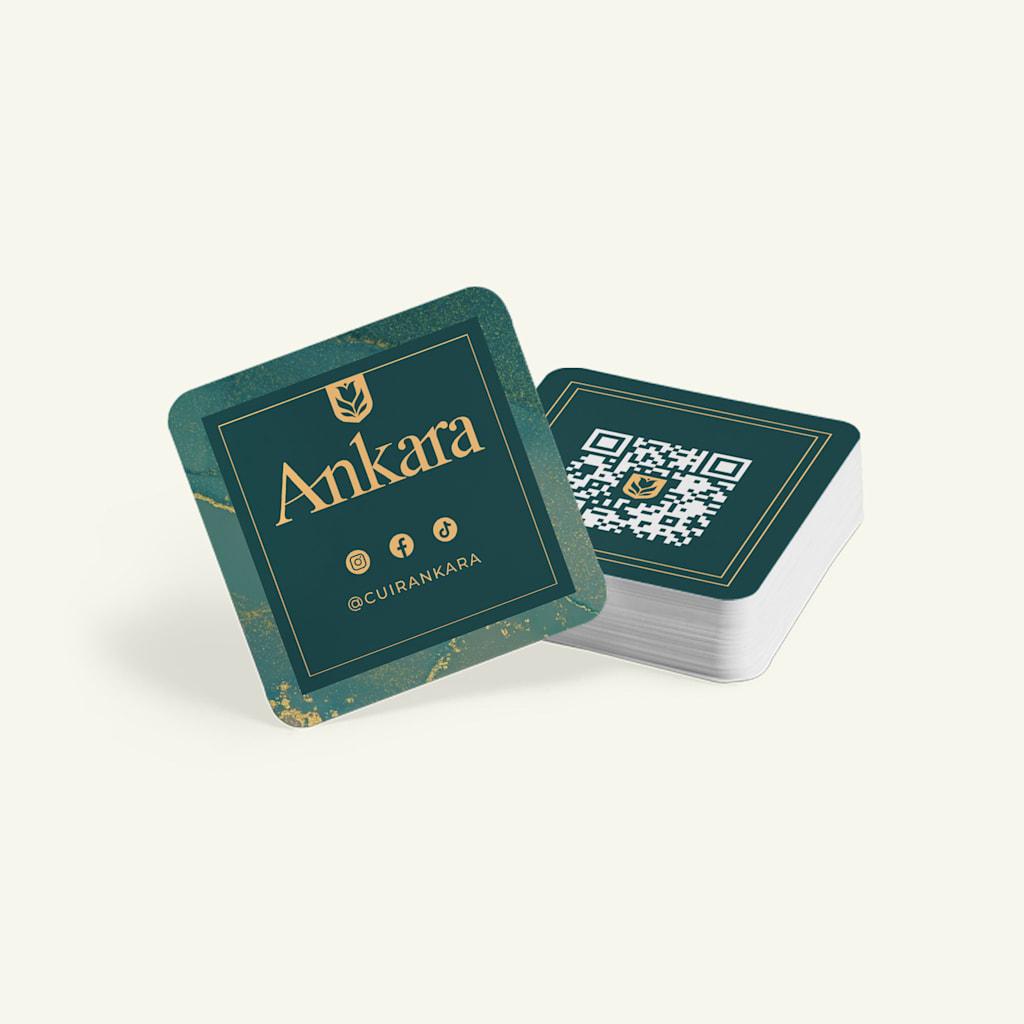
There’s nothing old-school about business cards – especially with all the modern design and print options out there. Go square instead of rectangular, choose rounded corners for a softer aesthetic, or pick a velvety finish for an irresistibly tactile experience.
Keep text minimal: business name, contact details and a short tagline that summarises what you offer. The main goal of a business card is to let someone who’s already interacted with you find you again – whether that’s in-store, by phone or online.

Flyers and leaflets
While business cards are brilliant for word-of-mouth and in-person moments, they don’t actively seek out customers. But flyers and leaflets do – and for most local shops, they offer some of the best value in print advertising.
Targeted flyers are inexpensive to produce, easy to distribute to nearby postcodes, and ideal for promoting new openings, seasonal offers or special events. They hit the sweet spot of low cost, local reach and measurable results.
But a cheap flyer and a cost-effective flyer aren’t the same thing. A flyer that goes straight in the recycling bin isn’t saving you money – it’s wasting it. What makes the difference? Three things:
- Give people a genuine reason to act now: a discount, a freebie or a limited offer.
- Make it obvious what to do next: include a phone number, QR code or address.
- Make sure it’s landing on the right doormats, not just the nearest ones.
Get those right, and a single door drop could realistically bring in 10 to 30 new customers from a £100 spend. Not bad for something that fits through a letterbox.


Posters and banners
Business cards and flyers work hard behind the scenes. Posters and banners are your shopfront doing the talking. They help create a visible presence in your community, turning everyday locations into opportunities to advertise.
They’re especially effective at reaching people who are already in the area and ready to buy, helping turn passers-by into paying customers.
Here are a few reasons simple signage like posters and banners are well worth investing in:
- They work 24/7 – no algorithm, no ad budget, no expiry date. A well-placed poster or banner promotes your business around the clock, whether it’s outside your shop, at a local event or in a busy community space.
- They help your small business look established. A professional-looking display outside a small shop signals permanence and credibility – “we’re here, we’re serious, we’re not going anywhere.” It gives customers the confidence that they’re buying from a trusted local brand.
- They’re highly reusable, especially banners. Once printed, they can be reused for markets, trade shows, local fairs and annual promotions, making them a cost-effective long-term investment.


How to bridge the gap between offline marketing and your digital channels
Print is clearly not dead. But that doesn’t mean you should put all your eggs in the offline marketing basket, either. Print and digital aren’t rivals. The most effective small business marketing doesn’t separate offline and online – it connects them. Print creates attention in the physical world, while digital channels capture and convert it.
For the customer, the journey rarely ends when they see a flyer or banner. In many cases, that moment is just the beginning – prompting a quick search, a website visit or a social media check-in.
With QR codes, short links and simple calls to action, posters, flyers and direct mail can now lead directly into digital experiences: your online shop, booking system, restaurant menu or your social media where the customer gets to know you better.
One of the biggest misconceptions about print marketing is that it’s difficult to measure. In reality, digital tracking tools make it easy to attribute enquiries and sales to specific campaigns. A unique discount code can reveal how many purchases came from a specific flyer; a campaign tracking number can measure phone enquiries while routing calls to your existing business line; and a custom landing page or QR code can track visits and conversions.
5 Small business marketing ideas using print (that actually convert)
Print works best when it gives customers a clear reason to act. These five low-cost ideas are designed to drive enquiries, repeat visits and word-of-mouth.
1. The “Refer a Friend” postcard
A simple postcard handed out in-store or included in bags that gives both the existing customer and a friend an incentive. It works especially well for salons, cafés, gyms, barbers or boutiques. It builds trust through word-of-mouth and adds a tangible prompt that doesn’t get lost in an inbox.
2. The joint flyer partnership
Team up with a complementary local business – for example, a florist and a wedding photographer, or a personal trainer and a health food café. Split print and distribution costs and reach each other’s audiences for half the price.
3.The upsell thank you note
Include a thank you card or a small postcard in every purchase or takeaway bag and add an incentive that inspires repeat purchases. For example: “Come back within 14 days for a free muffin with your coffee.” It reaches customers at peak satisfaction, when they’re most likely to return.
4. Community spaces and noticeboards
Community noticeboards, independent cafés, libraries, gyms and other local hubs can all be valuable advertising spaces. A well-designed poster in the right location can keep your business visible to the people most likely to visit. For best results, focus on one bold message and one action.
5. More than a business card
A simple business card can double as a loyalty card – stamped, ticked or marked each time a customer visits, with a reward after a set number of purchases. It turns a one-time interaction into a reason to return.
Tip
VistaPrint offers customisable loyalty card designs – you can easily adapt them to match your branding and print them directly onto the back of your business card.


